Start with a plausible failure
“Test the quality” is not a usable laboratory instruction. A better brief identifies what might go wrong: a strap could stretch, padding could remain compressed, a grip could wear smooth, or a textile could lose strength after exposure. The laboratory can then help select a method that measures a relevant property. The link to the finished product still needs engineering judgement and, where applicable, product-level tests.
A useful test programme combines an intended use, a failure mechanism and a decision criterion. Do not assume that the most expensive machine gives the most relevant answer. A simple dimensional check may resolve a concern about an undersized component, while a sophisticated tensile result may say little about repeated surface abrasion.
Tension describes pulling, not every load
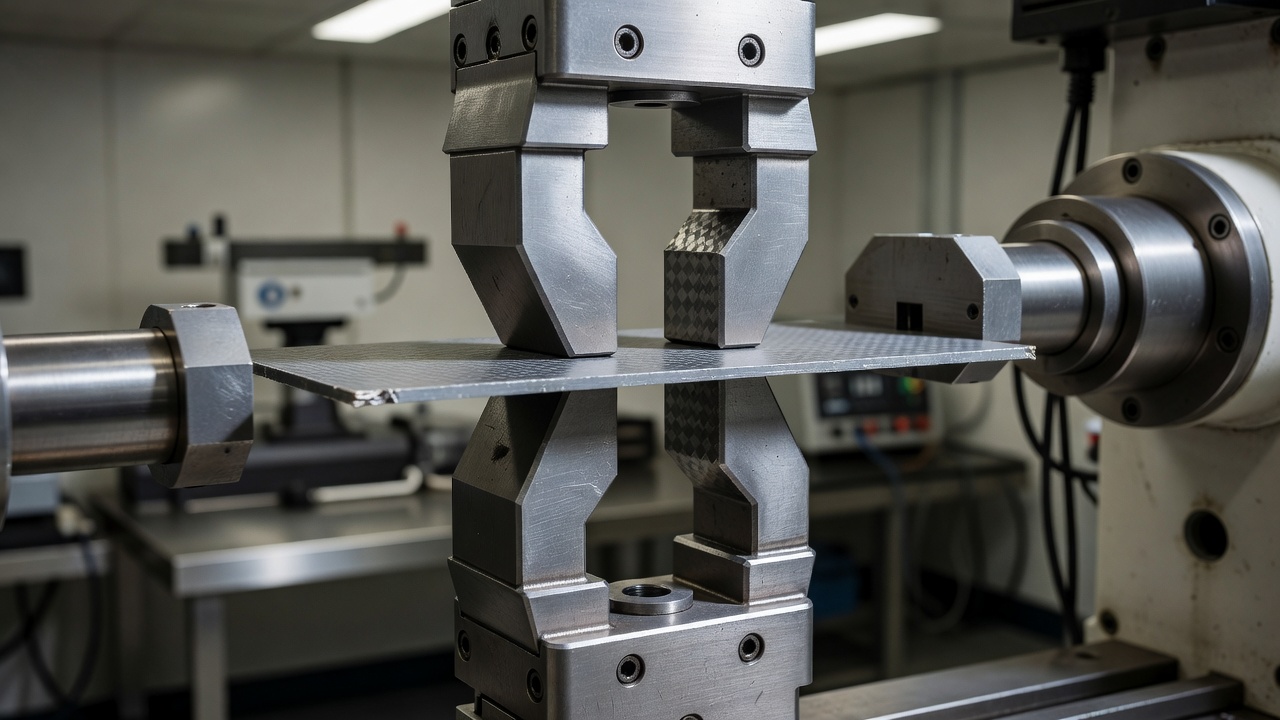
Tensile testing records a specimen’s response to a defined pulling action. Depending on the method, the output may include strength, extension or a modulus. Geometry, strain measurement, grip design and test speed all affect interpretation. A result from a plastic specimen should not be directly compared with a rubber specimen tested using a different procedure.
ISO 527-1 sets general principles for tensile testing of plastics. ISO 37 addresses tensile stress–strain properties of vulcanized or thermoplastic rubber. ASTM D638 is another established plastics tensile method. These references are not interchangeable labels. Ask the laboratory which part, specimen type and edition are suitable for the material, and keep the full method designation in the purchasing specification.
Compression and hardness answer different questions
Compression testing can describe how a cellular material resists deformation or recovers after loading. Indentation hardness is a more local response to a specified indenter under specified conditions. Neither alone proves impact protection. A protective assembly may depend on its geometry, available compression distance, shell interaction and retention system as well as the material itself.
ISO 3386-1 and ASTM D3574 provide relevant routes for some flexible cellular materials. ISO 48-4 and ASTM D2240 concern durometer hardness in their respective scopes. A hardness reading without its scale, dwell conditions and specimen suitability is incomplete. Stacking thin pieces or testing too close to an edge may also require attention under the selected procedure.
Abrasion is a contact system
Abrasion results depend on the abrading medium, applied load, movement, endpoint and specimen support. A textile tested until a specified breakdown endpoint is not directly comparable with a material assessed by mass loss in a different apparatus. “More cycles” is not automatically “more durable” unless the procedures and endpoints match.
ISO 12947-2 addresses specimen breakdown in the Martindale abrasion testing of fabrics. ASTM D4966 also concerns Martindale abrasion resistance of textile fabrics. Select the applicable method and report its conditions rather than combining results into an unsupported universal wear score. Real equipment may encounter grit, sweat, flexing and local pressure that are not fully represented by either procedure.
Ageing adds a history, not a lifespan guarantee
Exposure tests can investigate changes after heat, moisture or artificial weathering. ISO 4892-3 concerns exposure of plastics to laboratory light sources using fluorescent UV lamps. Its relevance depends on the material and exposure programme. A before-and-after comparison can reveal sensitivity, but it does not by itself convert laboratory hours into a reliable number of outdoor seasons.
Record the exposure conditions and the property measured afterwards. A specimen that looks unchanged may have lost mechanical performance; a colour change may occur without a proportionate loss in strength. If use involves cleaning products, salt or repeated washing, select additional evidence for those exposures. Avoid a broad “weatherproof” claim built on one narrow observation.
Compare like with like
Before ranking materials, align units, dimensions, conditioning, test speed, orientation, endpoint and summary statistics. Ask whether the reported value is a mean, an individual result or a derived figure. Small numerical differences may be less meaningful than specimen variability or measurement uncertainty. A ranking can be unstable when the evidence is sparse.
Finish the programme with the decision it was designed to support. A screening method can help select candidates without proving compliance. A standard material method can support a specification without certifying equipment. Product-level tests and the relevant conformity route remain separate questions. Keeping those boundaries explicit makes laboratory evidence more useful, not less.
Method families at a glance
| Question | Example references | Does not establish alone |
|---|---|---|
| How does it respond to pulling? | ISO 527-1; ISO 37; ASTM D638 | Complete equipment load capacity |
| How does foam respond to compression? | ISO 3386-1; ASTM D3574 | Impact protection of a finished assembly |
| What is its indentation hardness? | ISO 48-4; ASTM D2240 | Grip, comfort or overall durability |
| How does a fabric resist defined rubbing? | ISO 12947-2; ASTM D4966 | A universal service life |
| What changes after defined UV exposure? | ISO 4892-3 | A direct laboratory-hours-to-years conversion |
Source notes
Method titles and scope should be checked in the ISO catalogue and ASTM International catalogue. The examples are navigation aids, not instructions for performing a test. Obtain the applicable full standard and competent laboratory advice before commissioning work.